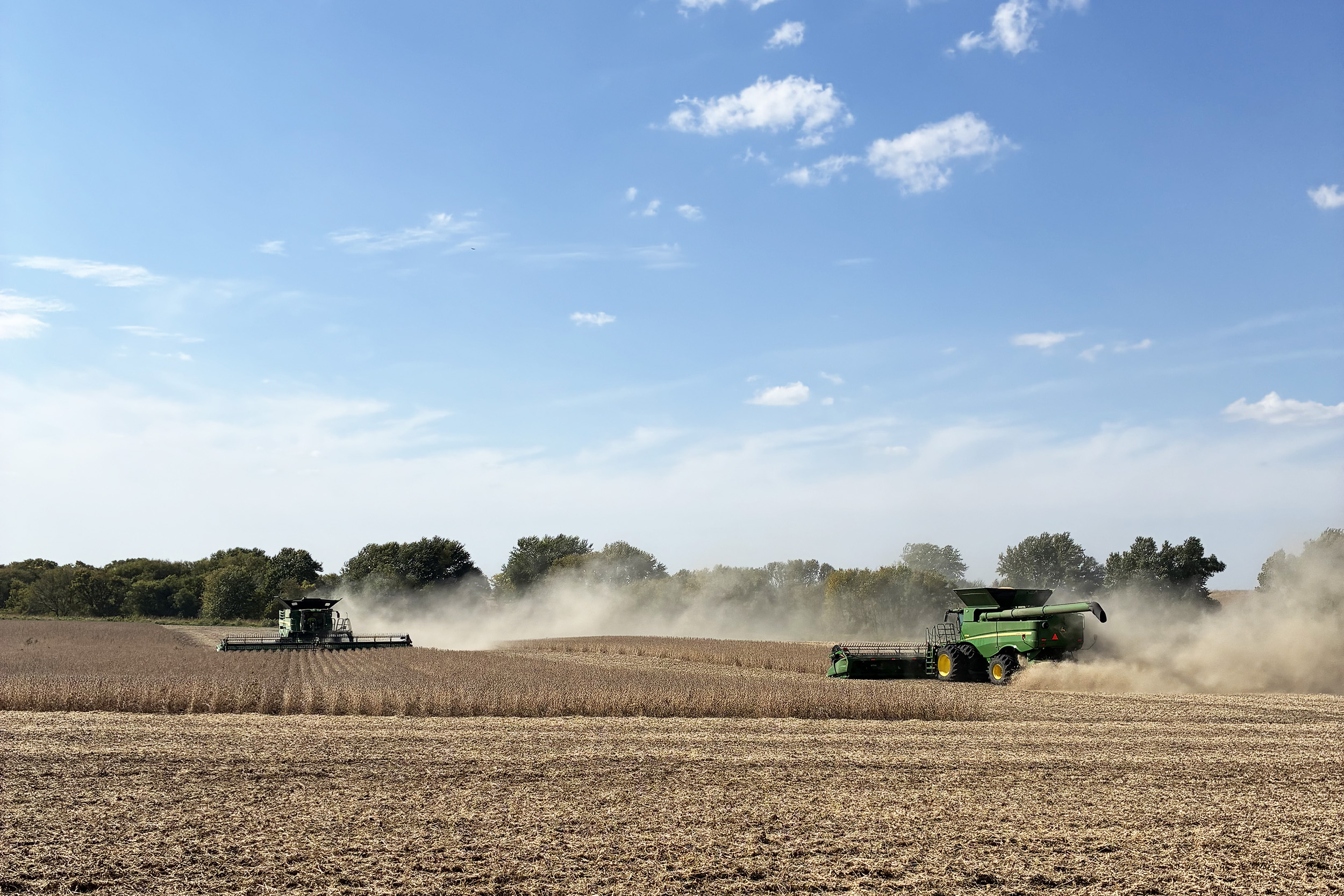
Across the Northern Soy Marketing (NSM) region – Minnesota and South Dakota – the harvest 2025 story sounds similar. The crop was bountiful, but the price was meager.
“It’s been really good,” NSM Vice Chair David Struck said. “The price is terrible, but we had good yields. The conditions were good, and we got soybean harvest done in a timely manner.”
Though price is still not where soybean farmers would like it to be, it has seen a few incremental increases.
“We were able to see the price bounce back up a little bit throughout harvest and that’s been welcome to see,” NSM Chair Glen Groth said.
While harvest itself went smoothly for NSM Director Patrick O’Leary, the crop was variable.
“Everything went as smooth as can be expected,” said O’Leary, who farms near Danvers, Minn. “We actually had a pretty good harvest as far as work getting done and a good harvest in general. We got on a roll, and it seemed to go pretty well. We had some really pretty good crop, and we had some really poor crop.”
Mother Nature was the culprit behind the crop that was below average quality.
“We had excess moisture early in the season and kind of all the way through the season, so the crop suffered from having too much water,” O’Leary said.
South Dakota NSM Director Carson Stange had a similar experience.
“Our soybean yields were a little on the disappointing side just because of all of the rain this summer,” Stange said. “The drowned-out spots really took a hit on the average yield.”
Because of the less-than-ideal price, many farmers across the NSM region opted to store the majority, if not the entirety, of their soybean crop until prices rally. This caused storage problems in many operations, including Struck’s farm near Wolsey, S.D.
“We ran out of room,” Struck said. “Every grain bin on our farm is full and now we’re dumping corn into flat storage. I guess that’s a good problem to have.”
Known for experiencing frigid, snowy winters, Minnesota and South Dakota farmers don’t always have the chance to complete fall field work after harvest wraps up. In fact, it’s not rare for the first snowflakes to fly while growers are still harvesting their crop. This year, however, producers are experiencing a long fall, giving them an opportunity to complete more projects on the farm before the ground freezes.
“We’re enjoying some unseasonably warm weather, so we’re getting a few things done in the fields that we wouldn’t have during a year where it cooled off faster,” O’Leary said. “We have hogs on our farm, so we just finished applying manure and we did a little tillage behind that. And then we’re doing tile work – repairs and things like that – that we sometimes don’t get a chance to get to.”
And for many farm operations, harvest is the part that producers look forward to all year, and once it’s over, the chore list bears down on them.
“Harvest is the easy part,” Stange said. “It’s the “I’ll worry about it after harvest” list that gets long.”
Despite the obstacles, for the most part, the growers who didn’t experience an abundance of rain reaped a quality crop.
“The quality is very good, as always,” Groth said.
O’Leary reiterated Groth’s sentiment.
“We had our challenges this year with weather, but in general, for the conditions we had, the quality of the crop looks quite good,” O’Leary said. “It was an okay scenario for the conditions we were put through in the summer.