Submitted by Lesley WJ Nernberg, Lighthouse Agri-Solutions and Matthew Clark, FeedGuys Resources
In the competitive poultry feed market, a paradox has emerged from recent analysis conducted in Southeast Asia: soybean meal (SBM) priced 5-7% higher than its South American counterpart delivered lower total feed costs across market conditions over a 12-quarter period. This counterintuitive finding challenges conventional purchasing wisdom and reveals why Northern U.S. Soybean meal deserves recognition in feed mill formulation strategies. The answer lies not in complicated economics, but in how your organization aligns purchasing decisions with nutritional science – a methodology we call the “War Game” approach.
Managing volatility: Oil prices, feed costs and KPI conflicts
Today’s commodity markets face unprecedented pressure, with forecasts suggesting the situation will intensify over the next 6-18 months. Crude oil prices, already elevated, are poised to rise further amid global geopolitical tensions and supply chain disruptions. These energy-cost increases directly affect fertilizer production and transportation, constraining fertilizer availability and driving prices upward. As a result, raw materials are expected to experience sustained price inflation throughout the coming years. Feed manufacturers already operating on thin margins now face the prospect of significantly higher feed ingredient costs precisely when cost control is most critical. Against this challenging backdrop, many feed mills confront a structural vulnerability as their purchasing and nutrition departments may be operating with misaligned incentives, leaving them unprepared to navigate the margin compression that rising raw material costs will create.
Purchasing departments are typically measured on ingredient cost and securing the lowest-priced soybean meal per metric ton. Nutrition departments, conversely, optimize for total feed cost while ensuring animal performance targets are met. When crude protein and commodity pricing metrics dominate purchasing decisions, superior nutritional ingredients are often excluded, even when they would reduce total feed costs. This disconnect creates what we call the “KPI Trap” where well-intentioned performance metrics inadvertently raise costs and compromise overall profitability.
What makes U.S. soybean meal different: The numbers behind the advantage
To understand the U.S. SBM advantage, we must look beyond crude protein percentages. While Brazilian SBM may show higher crude protein (46.9% vs 46% for U.S.), the standardized ileal digestible (SID) amino acid profile and energy tell a different story.
U.S. SBM delivers superior digestible lysine (2.68 vs 2.62 for Argentina), digestible methionine + cysteine (1.16 vs 1.12), and critically, higher apparent metabolizable energy for broilers (AMEn: 2300 kcal/kg vs 2218 for Argentina). Energy represents the single most expensive nutrient in broiler feed formulation. When soybean meal delivers higher energy, formulation efficiency improves dramatically.
Testing the theory: How war game simulations reveal hidden savings
The War Game methodology provides a practical framework for testing these nutritional advantages under real market conditions. In a recent Southeast Asia exercise, two competing teams were established with different purchasing strategies.
Team 1 focused on purchasing soybean meal at the lowest ingredient cost choosing between Argentine or U.S. origins. Team 2 prioritized achieving the lowest total feed cost while maintaining identical nutritional specifications. Both teams used the same feed formulations and faced identical market price fluctuations across 15 quarterly snapshots utilizing pricing data representative of the January 2020 through July 2023 timeframe.
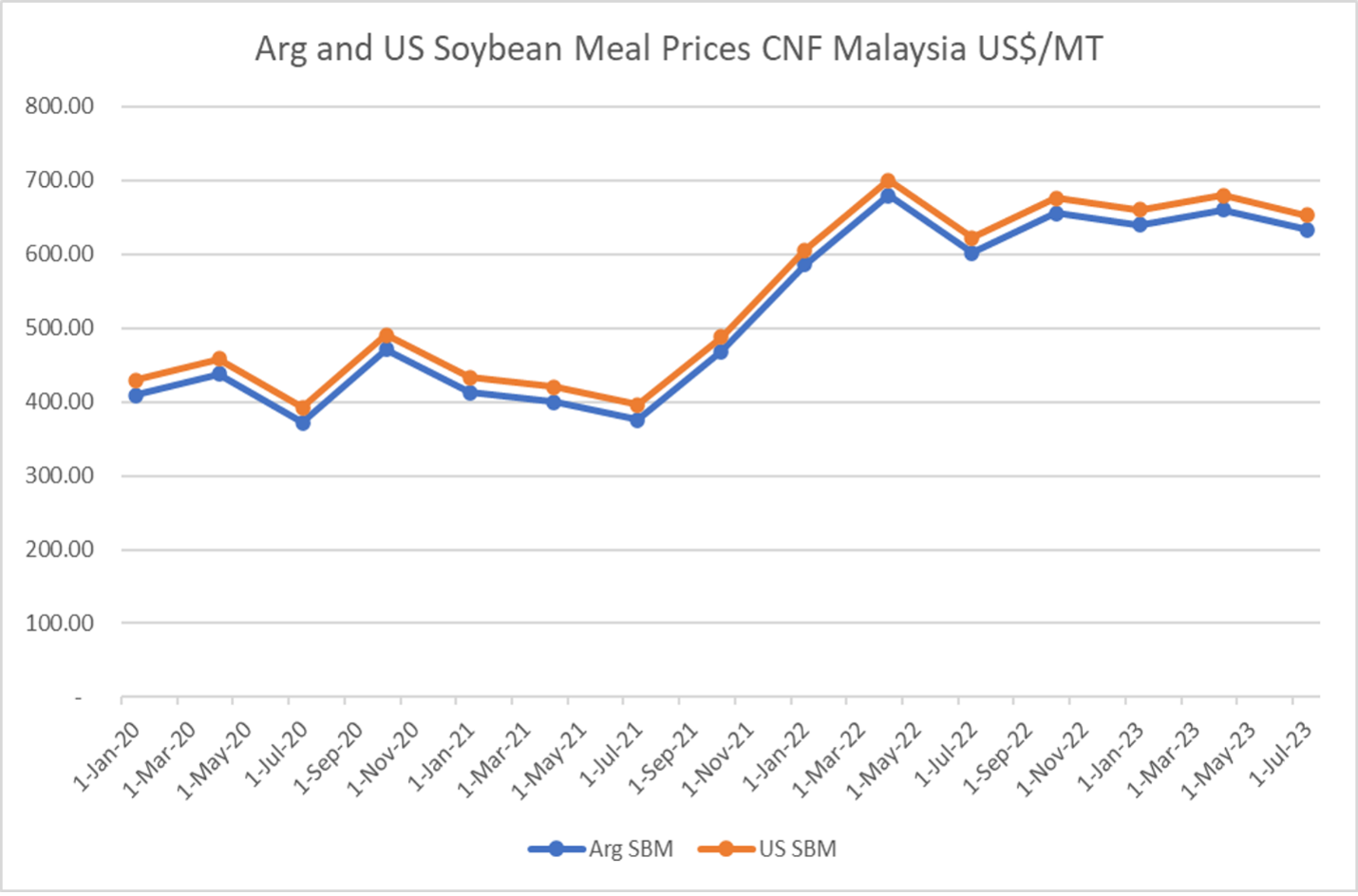
The results were decisive: U.S. SBM formulations consistently delivered lower total feed costs, despite the $20/MT price premium.
Southeast Asia case study: 12+ quarters of market proof
The quantitative evidence is compelling. Across 15 quarterly periods representing diverse market conditions, U.S. SBM formulas produced feed cost savings ranging from $3.87 to $19.67 per MT compared to Argentine SBM formulas. Interestingly, the advantage expanded precisely during volatile, high-price markets – the periods when cost control matters the most. 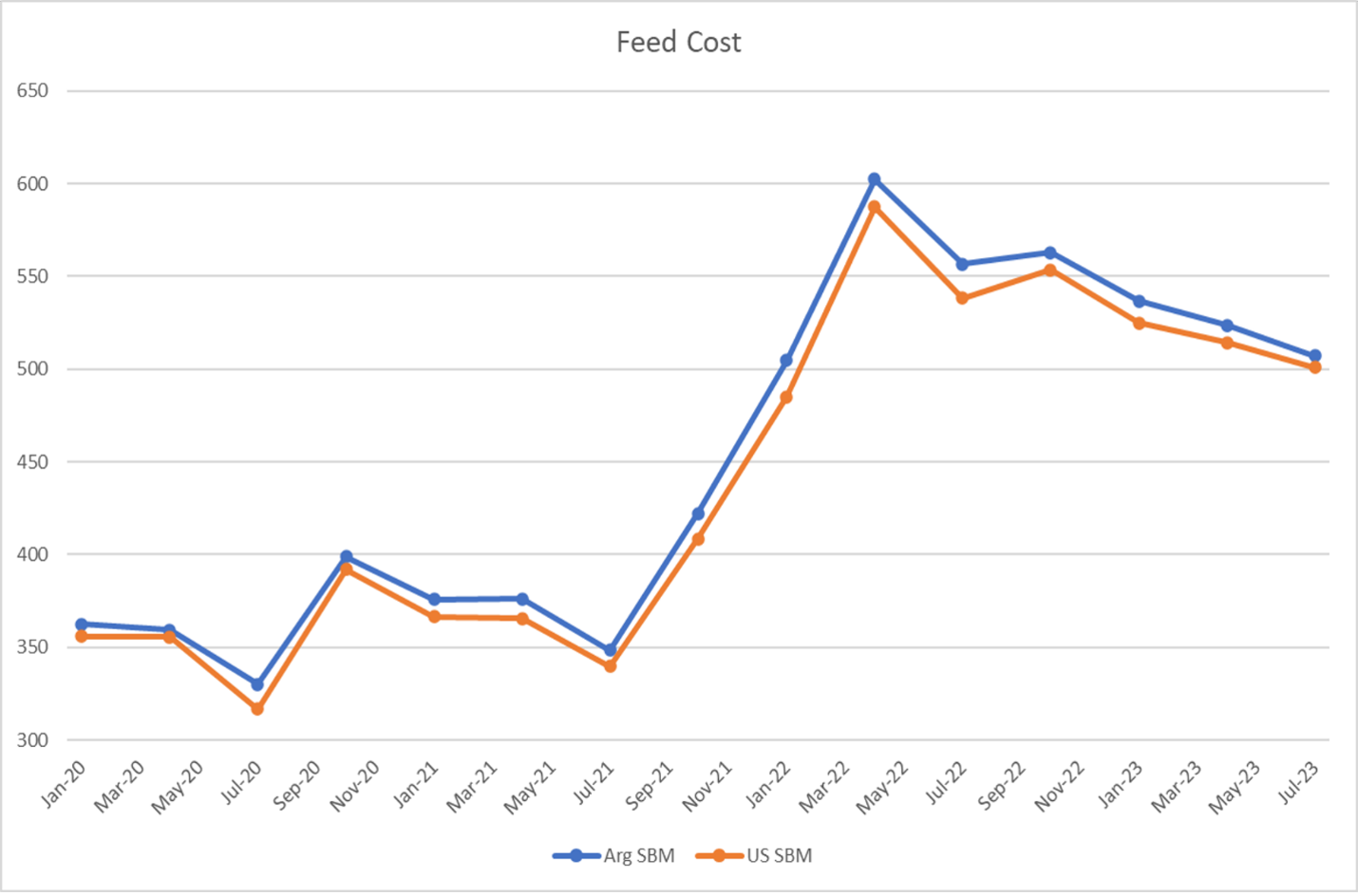
The largest single-period savings occurred in January 2022 ($19.67), during peak commodity price volatility when energy costs peaked. This finding is critical: U.S. SBM’s advantage is not marginal, it is material and grows under the challenging market conditions that manufacturers actually face.
Behind the scenes: How nutrient profiles drive formula adjustments
U.S. SBM’s higher energy content and superior digestible amino acid profile allows formulation software to increase corn inclusion rates while reducing both supplemental fat and amino acid additions. This formulation flexibility becomes increasingly valuable when feed fat prices surge – as they did dramatically during the test period – since less expensive energy sources can substitute for costly supplemental fats.
From the recent exercise, an analysis of the shift in nutrient component confirms this pattern: U.S. SBM formulas consistently incorporated more corn and less supplemental fat compared to Argentine SBM formulas. Although total SBM expenditure remained roughly equivalent between the two sourcing strategies, overall protein source costs declined due to the superior digestible amino acid profile of U.S. SBM, reducing the need for expensive supplemental amino acids.
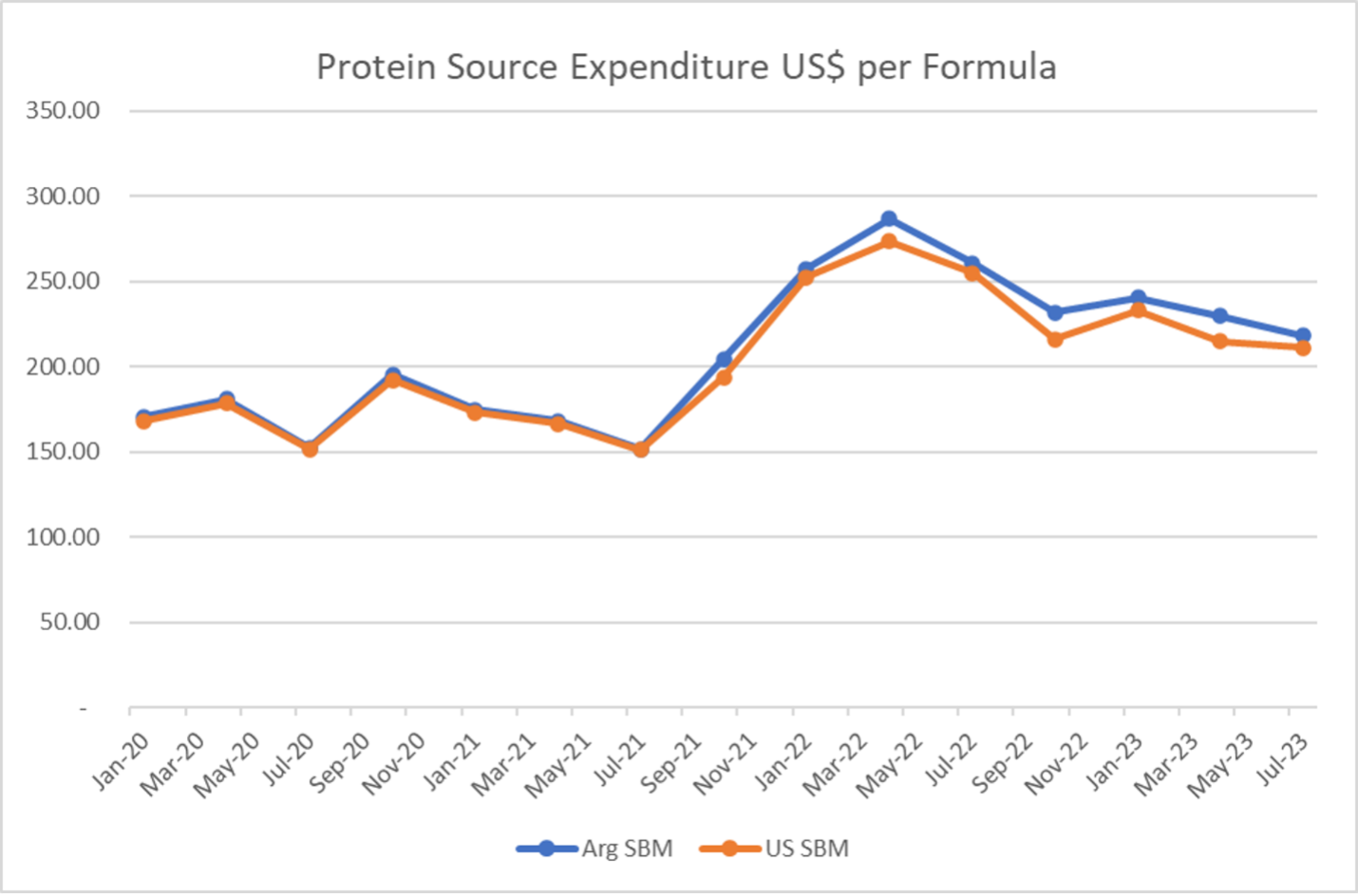 In this instance, it appears energy availability, not crude protein content, drove the formulation efficiency. This represents a fundamental shift from commodity-based purchasing (focused on named ingredient type) to nutrient-based purchasing (focused on biological value delivered to the animal).
War games: Training for aligned profitability
Understanding the KPI Trap is essential for implementation. When organizations measure purchasing success solely on ingredient cost, they inadvertently exclude superior value ingredients that would reduce total feed costs. The unintended consequence: cheap ingredients producing expensive feeds.
The War Game methodology provides more than data analysis – it functions as a powerful training and alignment tool. When purchasing and nutrition teams compete in formulation scenarios using real market data, several transformations occur:
- Participants experience competitive pressure and performance accountability simultaneously.
- Purchasing staff learn firsthand how ingredient choices cascade through formulation constraints and ultimately affect animal performance and profitability.
- Nutrition teams gain appreciation for market realities and cost pressures.
- Cross functional teams develop business cases supported by data rather than tradition.
More importantly, the War Game environment allows organizations to “stress-test” different KPI combinations before implementation. Teams can observe how alternative performance metrics affect decision-making and profitability – a learning that transfers directly to operational management.
Bringing war games to your feed mill: A practical roadmap
Implementing this approach in your operation requires the following process:
Step 1: Gather current nutrient data for SBM samples from your suppliers (Argentina, Brazil, U.S., etc.). University-validated nutrient databases provide standardized values for use.
Step 2: Establish baseline formulations for your key feed products (e.g. broiler starter, swine grower, etc.) using your standard formulation software.
Step 3: Set up competing teams (2-3 representatives from purchasing, nutrition, operations) and assign competing KPIs.
Step 4: Run quarterly scenarios using actual market prices – the Southeast dataset provides proven methodology and current references applicable to most markets.
Step 5: Track results against a profitability scorecard measuring both individual department KPIs and whole-organization feed cost and margin outcomes.
Transform your purchasing strategy: The evidence-based decision
The recent War Game scenarios in Southeast Asia are proof: U.S. soybean meal isn’t a cost – it’s an investment in consistent, profitable feed formulation. Across different pricing periods, from commodity booms to supply tightness, U.S. SBM’s superior nutrient profile produced measurable and documented savings.
The questions facing your operation is clear: Are your purchasing and nutrition departments aligned to capture these benefits? Or are conflicting KPIs leaving profitability on the table?
We invite you to assess your current soybean meal sourcing strategy using the frameworks and data presented here. Join us for hands-on War Game workshops where your teams can experience firsthand how strategic ingredient selection drives profitability.
The future of feed formulation belongs to organizations that align purchasing excellence with nutritional science. Let’s build that future together!
For more detailed data, analysis and technical support, contact Northern Soy Marketing or visit our website for the latest research and resources.