
By Lesley WJ Nernberg, Lighthouse Agri-Solutions and Matthew Clark, FeedGuys Resources
Soybean producers and poultry nutritionists alike stand at the crossroads of nutrition innovation and sustainability solutions, united by a shared commitment to performance, profitability, and environmental responsibility. Across industries, increasing demands are being placed on lowering nitrogen emissions and finding solutions for cost-effective soybean and poultry production. The unique nutritional profile and reliability of soybean meal from the northern U.S. states offer important advantages for both current and next-generation poultry feeding programs.
Capturing performance: Benefits of northern soybean meal
Soybean meal is universally recognized as the “gold standard” for protein in poultry diets, however, all soybean meal is not created equal. The cooler climates and specific agronomic, storage, and processing of soybeans from the northern U.S. results in meal products with distinct benefits, such as stable protein content, superior digestibility and a consistent and balanced amino acid profile. Northern soybean meal also delivers consistent levels of key essential and non-essential amino acids, making it ideal for supporting both conventional and reduced protein feeding strategies.
Essential vs. non-essential amino acids: What is the difference?
Amino acids are the fundamental building blocks required for protein synthesis in animals, facilitating lean tissue growth, development and the production of vital enzymes and hormones. In animal nutrition, these amino acids are divided into essential (indispensable) and non-essential (dispensable) categories. It is the quality, balance and bioavailability of individual amino acids, rather than total crude protein per se, that ultimately determines the nutritional value and effectiveness of a diet in supporting optimal animal growth, health and productivity.
- Essential amino acids (EAA) are those that animals cannot inherently synthesize in adequate amounts and must therefore be obtained from their diet.
- Non-essential amino acids (NEAA) can be created by the animal from metabolic precursors (carbon and nitrogen donors). However, these may become limiting in the animal when dietary protein is reduced and EAA needs are being met through crystalline amino acids, thereby reducing the NEAA supply from natural protein sources.
- The table below summarizes the key EAA and NEAA necessary for animal nutrition and highlights the levels typically present in soybean meal, demonstrating its value as a comprehensive source of both EAA and NEAA.
| Essential AA | % Total | Non-Essential AA | % Total |
| Lysine | 2.81 | Cystine | 0.66 |
| Methionine | 0.62 | Tyrosine | 1.75 |
| Threonine | 1.80 | Glycine | 1.97 |
| Tryptophan | 0.62 | Serine | 2.32 |
| Arginine | 3.38 | Proline | 2.35 |
| Isoleucine | 2.11 | Alanine | 2.01 |
| Leucine | 3.53 | Asparagine | 5.28 |
| Valine | 2.20 | Glutamine | 8.32 |
| Histidine | 1.21 | ||
| Phenylalanine | 2.36 | Total AA % (EAA+NEAA) | 45.30 |
*Source: As summarized from Evonik Amino Dat 5.0, 2024
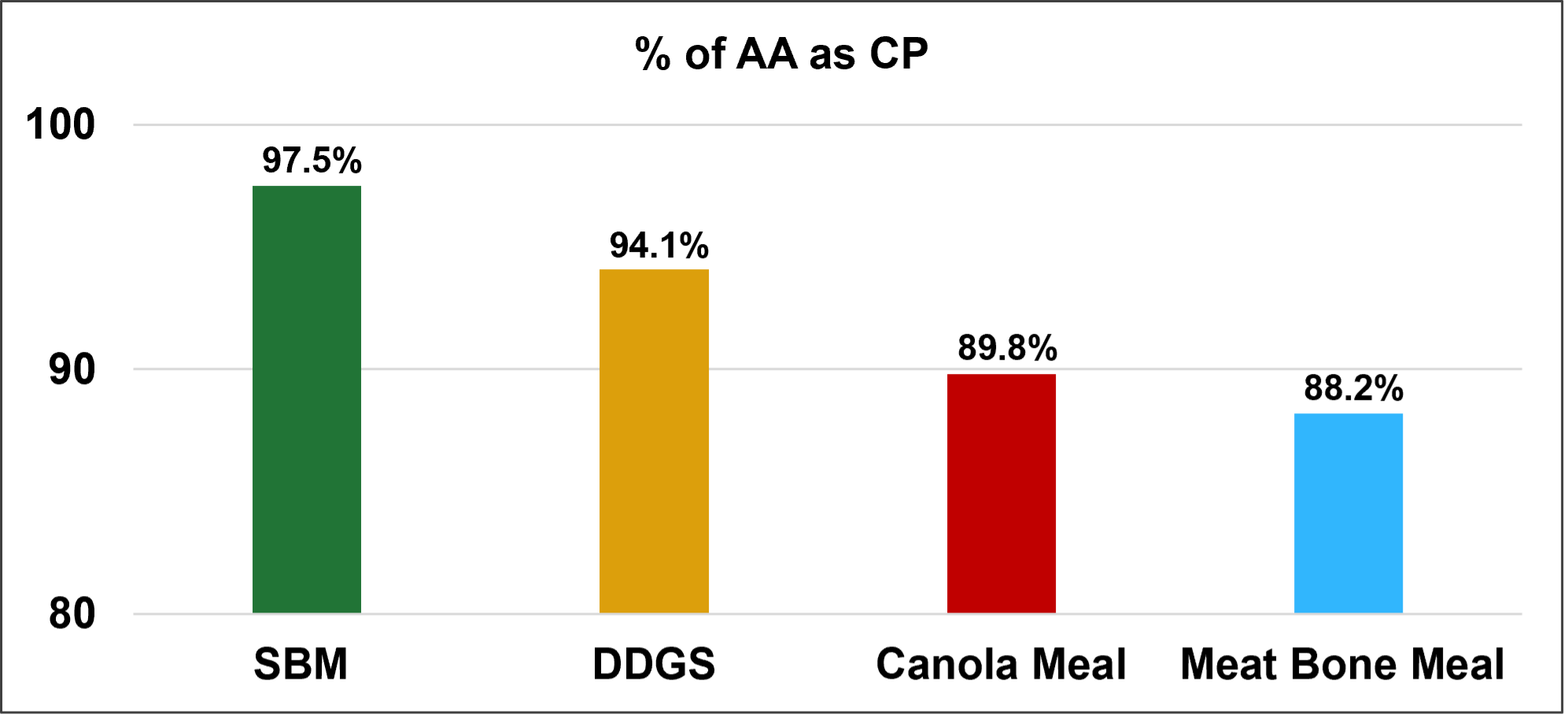
As mentioned, when evaluating protein sources for animal nutrition, it is not only the crude protein content that matters, but also the proportion of that protein present as true amino acids – comprised of both essential (EAA) and non-essential (NEAA). As illustrated below, soybean meal with a typical crude protein content of 46.4% contains 97.5% of its crude protein as total amino acids, making it the benchmark for protein quality among common feed ingredients. In contrast, alternative protein sources such as corn DDGS, canola meal, and meat and bone meal provide a lower percentage of amino acids relative to their crude protein content. This highlights why soybean meal is the industry standard for delivering a full spectrum of EAA and NEAA in animal diets.
Meeting modern demands: Sustainable low protein diets
The poultry industry is facing a paradigm shift toward lower crude protein (CP) diets – a move driven by the need to minimize environmental impacts (reducing nitrogen excretion) while still meeting bird health and productivity targets. While amino acid supplementation can assist in precise feed formulation, research confirms that going “too low” in crude protein can lead to shortfalls in NEAA’s such as glycine, serine and glutamine. These amino acids, while classified as “non-essential” are still critical for gut health, metabolism and protein synthesis, especially in rapidly growing broilers and high producing laying hens. Under such situations, the industry is looking at these amino acids as now being termed “conditionally essential.”
- When dietary protein is heavily reduced and EAA’s are supplemented from crystalline sources, NEAA levels from plant and animal-based feed ingredients can become limiting, leading to compromised performance and quality.
- Supplementing NEAA’s with synthetic products is currently expensive and logistically challenging. Maintaining a secure supply from natural feed ingredients, such as soybean meal, is both practical and cost-effective.
- Northern U.S. soybean meal plays a pivotal role in poultry diets by providing a comprehensive amino acid profile, including both essential and non-essential amino acids required for optimal growth and health
Northern soybean meal: Enduring value amid change
What makes soybean meal from the northern U.S. especially valuable is its integral role in maintaining balanced NEAA levels in modern, reduced crude protein diets. As some nutritionists pull back on diet protein levels for sustainability, the consistent NEAA supply from soybean meal ensures birds avoid poor growth performance or health – issues commonly observed when CP drops below approximately 18-19% for broilers or below 15-16% for layers.
- Soybean meal from northern U.S. states supports the strategy of precision protein reduction by ensuring a broad spectrum of both essential and non-essential amino acids in the final diet.
- This allows nutritionists to safely lower CP, reduce nitrogen output, and still maintain or achieve optimized animal performance and cost savings.
Real world results and economic advantages
Animal feeding trials reinforce that U.S. soybean meal can lead to higher gains in broiler growth and feed efficiency versus meal from other origins. This advantage is just not theoretical, recent feed formulation scenarios and broiler growth modeling simulations confirm the economic value.
- Broiler starter diets using northern soybean meal demonstrated up to $7.66/MT in feed cost savings with subsequent growth model simulations illustrating improved bird performance versus alternative sources.
- Lower variability in nutrient composition reduces the need for excessive safety margins, streamlining feed formulations and minimizing overuse of costly supplemental amino acids.
- Broiler growth model simulations reveal that even with reduced CP, northern soybean meal-maintained broiler gains and feed conversion ratios, offering financial and environmental benefits.
Supporting soybean producers and nutritionists: A shared win
For nutritionists, high-quality northern U.S. soybean meal delivers a consistent level of essential and non-essential amino acids needed to support optimal bird growth, whether in standard poultry feeding programs or innovative low-protein diets. Investing in U.S. soybean meal is a commitment to animal efficiency, predictable performance, and sustainability.
- Nutritionists can leverage the complete EAA and NEAA amino acid composition of northern soybean meal to formulate diets that keep birds healthy and maximize returns with the ability to refine levels of supplemental amino acids.
- For soybean growers and processors, these nutritional advantages provide a marketing point of differentiation – harnessing documented quality and consistency to translate directly to trusting relationships with feed mills and poultry operations, capturing value for soybean growers and end users alike.
A sustainable path forward: The northern soy advantage
In an era when poultry producers must juggle health, performance, cost and environmental impact – the value-added composition and amino acid digestibility of soybean meal derived from northern U.S. fields present an opportunity to unite sustainable agriculture and world class poultry nutrition across the globe.
Whether formulating for today’s conventional poultry feeding programs or tomorrow’s low-protein, eco-friendly feeds – northern soybean producers and poultry nutritionists both have much to gain through this strategic partnership.
For more information, insights and technical resources on maximizing the value of northern U.S. soybean meal in sustainable poultry production, visit Northern Soy Marketing’s website and technical resource center today.